
Medically reviewed by [Physician name to be confirmed by Dallas Renal Group]
Ask most people where their sodium comes from, and they point to the salt shaker. The truth is a bit sneakier. More than 70 percent of the sodium we eat comes from packaged and prepared foods, which means plenty of it hides in foods that do not even taste especially salty. If you are living with kidney disease or simply want to look after your kidney health, that hidden sodium is worth knowing about. This guide compares the sodium in everyday and high-sodium foods against common daily limits, so you can see how quickly a few ordinary choices add up. As a quick reference, general guidelines suggest keeping sodium under 2,300 mg a day, which is about 1 teaspoon of salt, and kidney guidelines often suggest aiming lower. We also share practical ways to keep enjoying your food while keeping sodium in check, along with everyday steps to support your kidneys.
People use the two words interchangeably, but they are not the same thing. Table salt is a compound of sodium and chloride, and sodium makes up roughly 40 percent of it. Nutrition labels list sodium, not salt, so the numbers on a package are milligrams of sodium. As a rough guide, one teaspoon of table salt contains about 2,300 mg of sodium.
Why does this matter for your kidneys? Healthy kidneys help the body balance sodium and fluid. When kidney function is reduced, that balancing act can get harder, and extra sodium may contribute to swelling, thirst, and higher blood pressure. That is why many nephrologists bring up sodium early and often.
Under 2,300 mg of sodium a day for most adults; 2,000 mg or less is common for people with kidney disease. The Dietary Guidelines for Americans set the 2,300 mg limit, which is roughly 5.8 grams, or 1 teaspoon, of salt. The American Heart Association points to 1,500 mg of sodium, about 3.8 grams or two-thirds of a teaspoon of salt, as ideal for most adults, especially people with high blood pressure.
Kidney guidelines land in a similar range. The KDOQI/NKF 2020 nutrition guideline suggests keeping sodium under 2,300 mg a day for adults with chronic kidney disease, and the KDIGO 2024 guideline suggests under 2,000 mg a day, which works out to around 5 grams of salt, a little under a teaspoon. Keep in mind that these numbers cover all the sodium in your day, including what is already in packaged and restaurant foods, not just what you add at the table.
Those are general reference points, not a personal prescription. The right target for you depends on your stage of kidney disease, your blood pressure, any swelling, and your other health conditions, so your nephrologist or a renal dietitian is the best source for your number.
Using 2,000 mg as our yardstick, a single can of minestrone soup can contain around 1,550 mg of sodium, which is roughly 78 percent of the whole day’s allowance in one sitting. One slice of frozen pizza comes in at about 900 mg, close to 45 percent, and a single tablespoon of soy sauce has around 880 mg, or about 44 percent. The mid-range items add up more quietly, and none of them feel like salty food, yet they stack up fast. Here is how they compare:
FoodServingSodium (mg)% of 2,000 mgCanned minestrone soup1 canabout 1,550about 78%Frozen pizza1 sliceabout 900about 45%Soy sauce1 tablespoonabout 880about 44%Deli pastrami2 ozabout 560about 28%Canned mixed vegetables1 cupabout 450about 23%Canned tuna in water3 oz canabout 200–300about 10–15%Deli ham1 sliceabout 290about 15%Canned tomatoes½ cupabout 220about 11%Ketchup1 tablespoonabout 150about 8%Fresh tomato1 wholeabout 6under 1%
Fresh foods tell a very different story. A whole fresh tomato has only about 6 mg of sodium, compared with about 220 mg in half a cup of canned tomatoes. These values are typical and vary by brand and preparation, so the label on your own food is always the best guide.
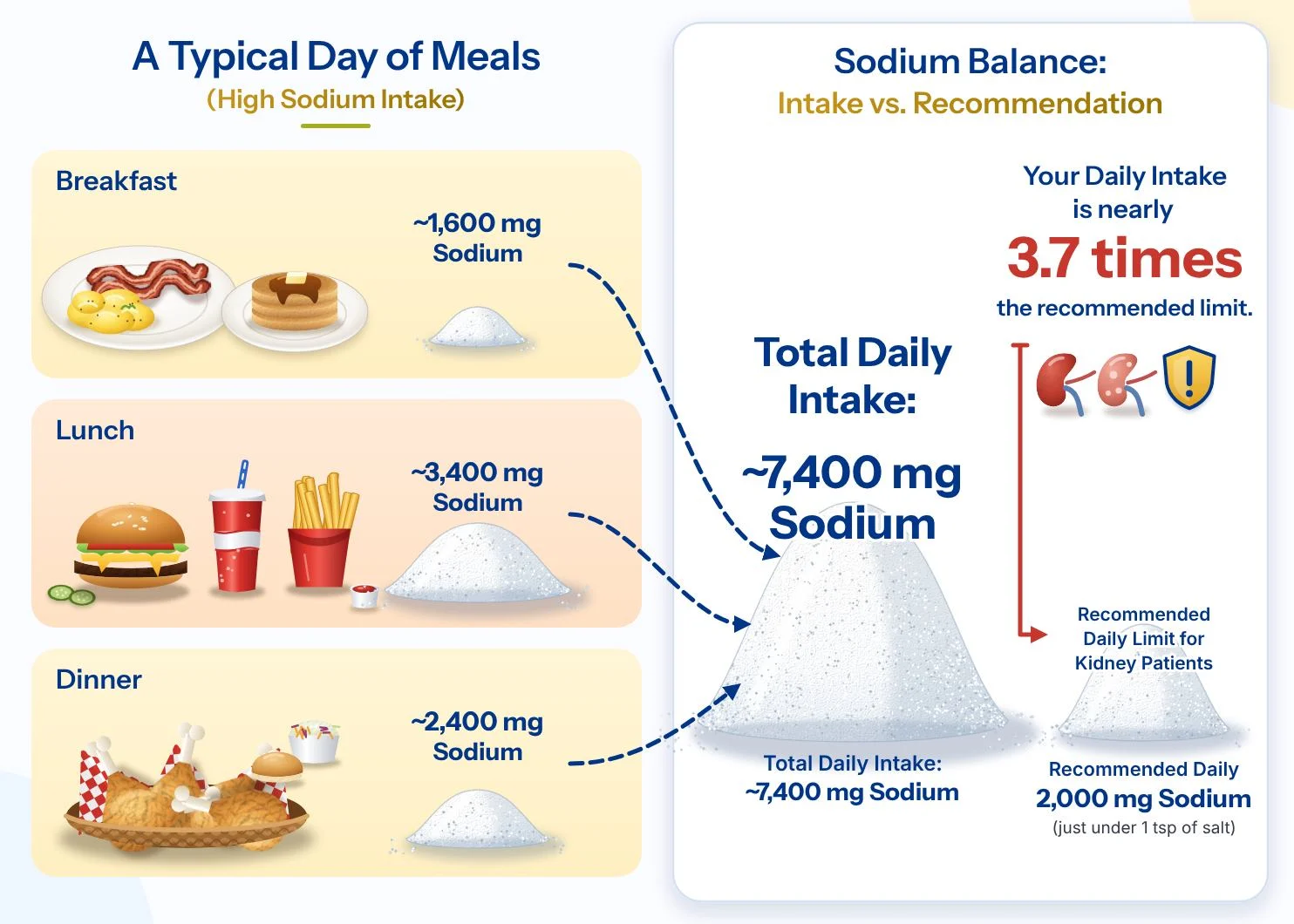
Let us walk through a made-up but very realistic day. You start with bacon and pancakes, grab a burger and fries at lunch, and sit down to fried chicken with sides at dinner. Nothing about that menu feels unusual, yet restaurant and fast-food meals often carry far more sodium than home cooking, and a day like this can add up to nearly four times a 2,000 mg limit.
For perspective, just three foods from the table above, a can of minestrone soup, a slice of frozen pizza, and a tablespoon of soy sauce, add up to roughly 3,300 mg. That is more than 8 grams of salt, well past the 5 grams a 2,000 mg limit allows, and it is only three items.
The point is not to feel guilty. It is to notice that sodium stacks up quietly across the day and that small swaps at each meal can bring a day back toward a more comfortable range.
You do not have to give up good food. A few habits go a long way:
Flip the package over and find sodium in milligrams, then check the percent Daily Value. As a general guide, 5 percent or less per serving is considered low, and 20 percent or more is considered high.
Also look at the serving size. If the label lists one serving and you eat three, you need to multiply the sodium by three. Some label terms can help too: low sodium means 140 mg or less per serving, and very low sodium means 35 mg or less. "Reduced sodium" only means at least 25 percent less sodium than the original product, so it can still be high. Keep in mind that no salt added does not always mean sodium-free, so it is worth checking the number. This simple check makes salty surprises much easier to spot at the store.
If you are unsure how much sodium is right for you, our nephrologists and care team can talk through your kidney health and explain what your lab results may mean for your eating habits. A renal dietitian can also help turn your sodium target into everyday meals. Whether you are newly diagnosed or have been living with kidney disease for years, your questions are welcome at Dallas Renal Group. Book an appointment to take another step toward protecting your kidney health, or find a kidney clinic near you. If you are not sure what to ask, here are some questions to bring to your nephrologist.
Q: How much salt is recommended per day?
A: General guidelines suggest keeping sodium under 2,300 mg a day, which is about 5.8 grams, or roughly 1 teaspoon of salt. For people with kidney disease, 2,000 mg or less is common, which is just under a teaspoon of salt. Your nephrologist can help you find the number that fits your health.
Q: What are some of the most common high-sodium foods?
A: Canned soups, pizza, deli meats, soy sauce and other sauces, canned vegetables, and restaurant or fast-food meals are common sources. Breads and rolls add up too, because many of us eat them several times a day.
Q: How much sodium is too much in one meal?
A: There is no single number for everyone. As a rough example, someone aiming for 2,000 mg a day might plan around 500 mg per meal and leave a little room for snacks, but your care team can set a plan that fits you.
Q: Is sea salt or pink salt lower in sodium than table salt?
A: Generally no. Specialty salts still contain sodium, so they count toward your daily total.
Q: Why do salty foods make me thirsty?
A: Sodium attracts water, so a salty meal may leave you feeling thirstier. That can be tricky if you have been asked to limit fluids.
Q: Can foods that do not taste salty still be high in sodium?
A: Yes. Breads, cold cuts, and canned vegetables can carry a surprising amount of sodium without tasting salty, which is why the label matters more than the taste.
Q: Does "reduced sodium" mean the same as "low sodium"?
A: No. "Low sodium" means 140 mg or less per serving. "Reduced sodium" only means at least 25 percent less sodium than the original product, so it can still be high.
Q: Should I talk with a nephrologist about my sodium limit?
A: It is a good idea. Your target depends on your kidney function, blood pressure, and overall health, and our team can help you understand what that means for your daily meals.